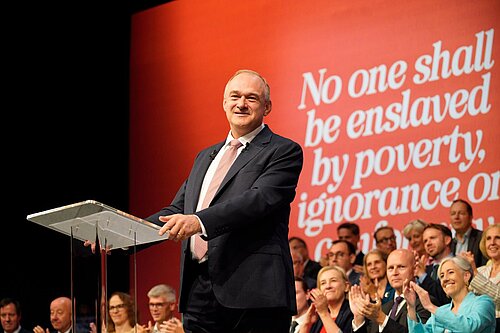
Latest UK News
The Fight of our Lives
Ed Davey's Leaders' Speech to Autumn Conference Speech 2026
ED
by Ed Davey
22 Sep 2026
Sticking with volatile fossil fuels is a recipe for permanently high household bills and compromised national security.
Despite right-wing assumptions of cheap, falling gas prices completely collapsing under the weight of geopolitical crises in Ukraine and the Middle East, the Conservatives and Reform UK want to replicate Donald Trump’s rollback of renewables and continue to gamble Britain’s energy independence on the whims of foreign dictators.
The Liberal Democrats disagree - cutting green investment only lines the pockets of hostile foreign regimes while pushing up household bills.
Speaking at Energy UK's Annual Conference, Ed Davey challenged the Government to establish a state-backed Energy Security Bank funded by a windfall tax on commercial banks' quantitative easing profits.
This would deliver low-cost loans of up to £20,000 for households and £50,000 for small businesses to insulate properties, install heat pumps, and fit solar panels, shielding consumers from future international market shocks.
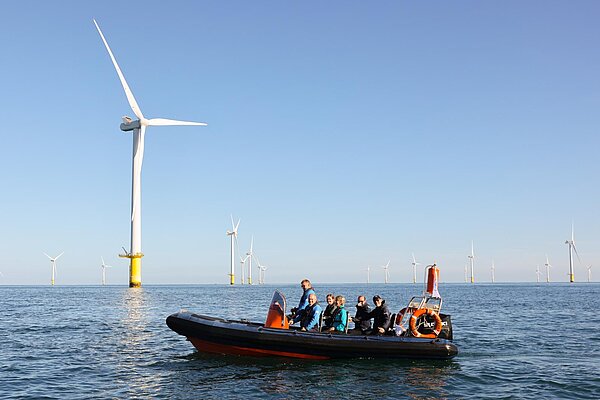
Last month, when I was down in Brighton for our party conference, I had the great joy of going out in a boat to visit Rampion Wind Farm, a few miles off the south coast.
It was a special moment for me. Because a little over twelve years ago, I was the Secretary of State who gave the go-ahead for construction to begin.
It didn’t happen by accident. In government, our party - working with your industry - made Britain the world leader in offshore wind.
We did it by launching a dedicated industrial strategy. Creating the Green Investment Bank – the first of its kind, anywhere in the world. We did it by leading the world in introducing contracts for difference, with competitive auctions. We did it by showing we were serious. And we attracted global firms to come to the UK, and invest tens of billions of pounds building wind farms like Rampion.
And so, that project went from being a stack of papers in my ministerial red box to the incredible feat of engineering you can see from Brighton pier.
116 turbines, each one 460 feet tall. Together generating enough cheap, clean, renewable energy to power 350,000 homes. Cutting carbon emissions by 600,000 tonnes every year.
With the many other offshore wind farms built off our island, a remarkable achievement of government working with business to deliver for our country.
The crucial element of our success, in my view, was being clear and consistent about our goals. Setting a framework that allowed industry to invest – with stable and predictable policies.
Policies that not only got the wind farms built, but got prices down and protected the consumer.
Now, let me surprise you: it wasn’t easy. We had fierce opposition – especially from some of the Conservative Ministers in that coalition government. Conservatives who argued that renewables would just be too expensive. That we were better off relying on cheap gas – even as Vladimir Putin back in 2014 sent his troops into Ukraine and annexed Crimea.
We won those economic and cost arguments back then – and we have to win them again.
Because we are once again faced with politicians on the right – in both the Conservatives and Reform – whose whole energy strategy is to tie us ever more tightly to volatile gas prices, believing against all historic evidence that gas prices won’t just go low at some time in the future, but stay low in the future.
Now, I just can’t see how they can have lived through the last five years and still be arguing for that.
Not after Putin’s invasion of Ukraine caused household energy bills to more than double. Not after the government had to shell out 44 billion pounds of direct support to households and businesses over a period of just 18 months. And not after what we’ve seen since Donald Trump started his idiotic war with Iran back in February. Sending gas prices soaring and pushing energy bills up again – with a much scarier rise now expected in January.
Maybe it’s because of their record of cheering on President Trump that Farage and Badenoch want us to forget all about this.
Just look at the assumptions behind the Conservatives’ so-called “Cheap Power Plan”. It all relies on gas prices having peaked at 108 pence per therm this year, and then falling steadily over the next 15 years.
Remember that. For the Conservatives’ plan to add up, gas prices had to have peaked at 108 pence per therm.
On the day the Conservatives published their plan, the gas price was 157 pence per therm. Today, it’s 209.
The point is this. Gas prices are volatile. Gas shocks are inevitable. If your energy strategy relies on the Russian President never invading territory in eastern Europe, or the US President never launching a foolhardy war in the Middle East – well, it’s not a very good strategy.
And I haven’t started on their optimism bias on nuclear power costs and development timescales. And I say that as the last Energy Secretary to have signed off a nuclear power plant.
But it’s not enough for me to stand up here and tear their plans apart. Although I must admit, I do quite enjoy it, as it’s so astonishingly easy!
We have to offer a better plan. A plan to bring down energy bills. To tackle climate change. And to strengthen Britain’s energy security. The trilemma you might remember.
And while our energy plan has many parts – let me focus on three key ones. Expanding renewables. Upgrading our energy efficiency. And investing in battery storage.
Let me start with renewables.
Because the single biggest thing we can do to boost our energy security – and to break the link between volatile gas prices and energy bills – is to invest in renewables.
Power that we generate here at home. That no dictator can switch off. And where the price doesn’t spike because of global events, but instead comes down over time.
We know how to do it, because we’ve done it before. During our five years in government, we quadrupled Britain’s renewable power – and we can do that again, if ministers show the same direction and clarity, stability and leadership.
From developing our CfDs still further to a stronger approach on planning and consent, to an industrial strategy for key supply chains and a myriad of policies on everything from improving grid connections to system flexibility.
But here’s what we mustn’t do – and that’s to follow the path Donald Trump is treading in the United States. He is paying billions of dollars of taxpayers’ money to energy firms to cancel renewable projects that were already underway. Trump has cancelled projects that would have generated 28 gigawatts of cheap, clean electricity. That means fewer jobs, higher bills, higher emissions – and, as we’ve seen this week, more dependency on dictators like Vladimir Putin.
That is Trump’s America – and now we have Reform and the Conservatives trying to do the same here in Britain.
We must not let them win.
And yes – that means defeating their argument that it’s all just too expensive. Fixing the broken electricity market so people and businesses see the benefits of cheap renewables in their bills. Putting in place a strategy to upgrade the grid without hiking up those bills, including consumer-led flexibility and storage. And rejecting the lie that the grid somehow wouldn’t need upgrading if we just stick with gas. Of course it would.
The second part of our plan is energy efficiency.
It’s the least glamorous part of energy policy. There are no ribbon-cuttings. No boat trips. But it’s one of the cheapest and fastest ways to cut bills. Because the cheapest energy of all is the energy you never have to use.
It’s why we have been pushing for an urgent, comprehensive programme to upgrade people’s homes. Insulating them so they’re cheaper to heat. Helping people switch to heat pumps. Requiring solar panels on all new homes – thanks to my colleague Max Wilkinson’s Sunshine Bill last year.
But just last week, the Conservatives announced they want to scrap that requirement and the Future Homes Standard. A move that might help pad the profits of housing developers, but would add thousands of pounds to the energy bills of people who live in those homes.
A policy like that can only come from a party that doesn’t understand the cost-of-living crisis, doesn’t understand the real problems in our housing market and hasn’t learnt anything from its failures in government.
But it’s not just the Conservatives. This week it was reported that Labour ministers are preparing to cut subsidies that help families to install heat pumps, in order to fill a tiny bit of their black hole on defence spending. I hope that’s wrong, and all I’ll say is this. You will not make us safer – and more secure – by undermining energy security.
Energy security is national security. Go talk to the Ukrainians.
That’s why Pippa Heylings, our brilliant Energy Spokesperson, has led calls for a National Electrification Strategy – to help break the reliance on gas and reduce electricity bills.
And it’s why our Treasury Spokesperson Daisy Cooper has set out plans to invest in energy upgrades for homes and businesses through a new Energy Security Bank – building on the success and lessons from our Green Investment Bank.
Funded initially by a windfall tax on the big, unexpected profits banks have made as a result of quantitative easing, our Energy Security Bank would work with industry and consumers to create a stable, predictable, long term financial framework to reduce and in time replace methane gas in the UK’s heating system.
Starting with affordable loans of up to £20,000 to families and £50,000 to small businesses, to invest in energy efficiency and new technology to bring down the nation’s energy bills.
And the third part of our plan: storage.
Because we’ve all heard the questions, haven’t we? What about when the wind doesn’t blow? What about when the sun isn’t shining?
There are of course a myriad of answers here too. From interconnectors like the North Sea Link which I initiated as Secretary of State to new pump hydro storage, we know the options.
But in the last decade or so, industry and technology have made dramatic breakthroughs in the most exciting storage option. Batteries.
Another great news story alongside wind and solar of brilliant innovation and rapidly falling costs.
Back when I was Energy Secretary – a little over a decade ago – when I asked about batteries – as I often did – I have to admit I was met by sucking of teeth. Predictions that nothing serious would happen till the 2030s.
Large-scale batteries were a curiosity. Expensive, experimental, and certainly not a consideration for homes, offices or factories.
But outside Whitehall – when I took a two-year sabbatical from Parliament – I discovered a different reality and a different future for battery storage.
That excited me – and convinced me that intermittency challenges, network costs and back-up costs were all problems that could be solved for a renewables future.
Since then, it’s happened. Thanks to the wonders of mass-production – the cost of lithium-ion batteries has fallen by more than 80 per cent.
That’s one of the most dramatic price falls of any technology in modern history. And British industry has responded. Battery storage capacity has gone from just ten megawatts a decade ago to nearly seven gigawatts now. An incredible 700-fold increase in capacity.
This year, for the first time ever, batteries have overtaken the combined capacity of all Britain’s nuclear power stations. People are installing them in their homes in record numbers – tens of thousands already this year – and they are saving hundreds of pounds on their bills as a result.
So the foundations are in place. Now we need to build on them. Because the prize is enormous. Every gigawatt of storage we add means less wind or solar power wasted. Making our overall system cheaper and more efficient. Fewer expensive gas plants setting the price on the coldest, darkest evenings.
Because people can rely on the clean energy stored in their battery, rather than needing to burn gas to stay warm. And a grid that can handle the cheap, clean, homegrown power we’re generating.
Think of it as the missing link. Renewables give us cheap power. Batteries make sure we can use it whenever we need it. Together, they are the best guarantor of our energy security. The best way to bring down energy bills. And the best way to protect ourselves against the next gas shock.
So we need the government to step up, like we did on renewables when we were in power. With a dedicated industrial strategy and financing for battery storage. Giving businesses the stability and certainty they need to invest. Showing we’re serious.
Britain led the world in offshore wind. Let’s do the same on energy storage.
So that’s the choice.
On one side, an insecure future of volatile gas prices, cancelled investment, and cold, leaky homes. Trump’s America imported to our United Kingdom.
On the other, a future of cheap, clean power – generated here in the UK. Heating our homes and fuelling our businesses.
I know which one I want. And we can build it together.
Twelve years ago, I had to fight to sign off investment in wind farms like Rampion. Fight to bring supply chain investment to places like Hull. Fight to create a cost reducing, stable investment regime.
Now, when I look out at those turbines off the coast of Brighton, I am glad we won those fights.
But the fight ahead is even bigger. Because our opponents are more extreme, and much better funded.
But we have the facts on our side. We have great British innovation and ingenuity on our side. And we have the great British public on our side.
So we can win the argument again now – if we have the courage to make it with conviction – and yes, with energy.
That is the path to lower bills, a safer climate, and a stronger, more secure Britain.
Let’s choose it together.
Thank you.
Ed Davey's Leaders' Speech to Autumn Conference Speech 2026
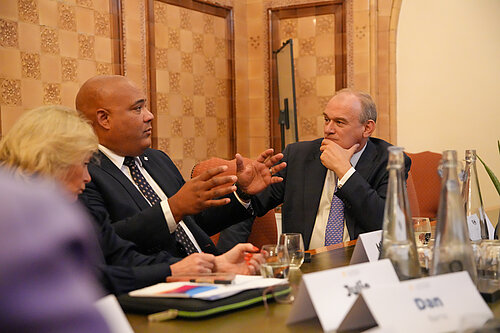
Ed Davey’s speech from the Liberal International’s London Security Conference 2026 at the National Liberal Club

The Liberal Democrats have announced a new policy to make energy affordable again and help make fuel poverty a thing of the past.