
Cost of living
Our Essential Energy Guarantee
The Liberal Democrats have announced a new policy to make energy affordable again and help make fuel poverty a thing of the past.
8 Jun 2026
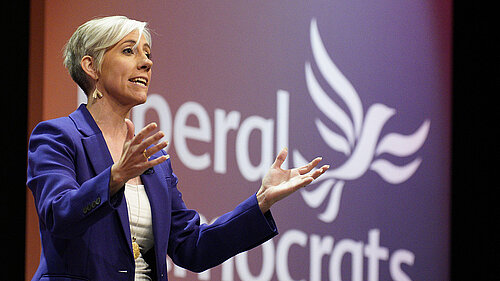
Liberal Democrat Treasury Spokesperson and Deputy Leader Daisy Cooper MP has today unveiled a radical plan to ‘Get Britain Growing Again to end the cost of living crisis’.
Liberal Democrat deputy leader said “we don't just need to get rid of this anti-growth Chancellor, we need to get rid of the anti-growth Treasury.”
The new powerful Department for Growth would have a clear mandate to boost long-term prosperity and end the cost-of-living crisis. It would have responsibility for setting taxes, along with putting together a growth strategy, deciding on strategic national infrastructure projects and setting fiscal rules.
We Liberal Democrats believe that we should talk up our country.
We are one of the world’s leading economies. Our financial and professional services sectors make us a trade superpower. And we are uniquely placed in having the combined advantage of language, law and location.
We have strong institutions. Dynamic markets. Universal public services.
We have world-leading universities, creative industries, and life sciences. We are the third largest market for artificial intelligence. And we have awesome entrepreneurial people.
Our United Kingdom is an amazing country and has enormous potential.
But we can never take this for granted. And we must accept that we are stuck in a rut. Stuck in a doom loop of low economic growth. And that is a big problem.
Economic growth matters.
We need to Get Britain Growing Again to end the cost of living crisis.
We need to Get Britain Growing Again to rebuild our public services.
We need to Get Britain Growing Again to invest in the climate transition and create the well-paid climate jobs of the future.
If we don’t Get Britain Growing Again then we’re trapped: trapped paying more and more, but with less and less.
It’s why everyone is working harder and harder. Paying more and more in tax. And getting less and less in return.
So Getting Britain Growing Again must be any government’s number one goal.
Now, the Labour government says that its number one mission is growth.
But too many of its policies are anti-growth.
Even next month’s Prime Minister Wes Streeting thinks there’s “No growth strategy at all”
Labour has made lots of mistakes. But for me, one of the worst - is that they knew for months they would win the General Election, but they just weren’t ready.
No plan. No vision. No change.
Instead, their government - like governments before them - reverted to ‘Treasury brain’.
The Winter Fuel Payment fiasco. A short-term Treasury tax-grab driven by the desire for immediate bankable cuts.
The jobs tax. A short-term Treasury tax-grab with no regard for the crushing impact on employment, investment or growth.
The family farm tax and the attack on family businesses. Short-term Treasury tax-grabs by the Chancellor that could lead to some of the most resilient long-standing British businesses being broken up and sold off.
The list goes on.
But this isn’t a new problem.
For too long, political parties without a vision for growth have allowed the Treasury tail to wag the political dog.
And it must stop.
For decades, everyone has identified this as a problem.
The Treasury does too much. Fiscal policy, economic policy, and controlling government spending. In most other countries, these roles are split up.
The Treasury enables governments to go for short-term tax grabs that suit political cycles over the need for long-term growth.
The Treasury is disconnected from the real economy. Despite holding all the economic power, the Treasury isn’t responsible for policies on business or trade.
This leaves British business jumping through hoops, speaking to three, four, five different government departments before they can get an answer.
In short - the Treasury is over-centralised. It drives short-term thinking. And it simply isn’t designed to deliver long-term economic growth.
Some think it can be tweaked here and there. Some want to centralise it even further by putting some of its power in the hands of the Prime Minister.
We have a more radical plan.
Today I can announce that we Liberal Democrats don’t just want to get rid of this anti-growth Chancellor. We want to get rid of this anti-growth Treasury.
As part of our plan for government, we would break up the Treasury - and replace it with a new powerful Department for Growth.
A new Department for Growth with a mandate to boost long-term prosperity, improve living standards and end the cost of living crisis.
The Department for Business and Trade would be merged into this new growth department, recognising the central role of British business in driving growth.
And a smaller Department for Public Expenditure would be set up to oversee departmental spending and ensure value for money.
This new Department for Growth would focus minds on what growth could help us achieve:
And the Department for Growth could help re-set the relationship between government and business too:
In splitting up these functions into different departments, we would be following the lead of other major economies: like Ireland, America, Australia.
But we wouldn’t stop there.
For centuries, the UK government has been too London-centric. “Whitehall” is short-hand for “calling the shots”.
We Liberal Democrats are the only political party with MPs that span from the highlands and the islands of Scotland down to the tip of the South West, so we know, we see the differences in economic growth between the South East and everywhere else.
So we think it’s time for change.
Under our plans, the new Growth Department wouldn’t just have a focus on getting growth beyond London.
The new Growth Department would itself be based outside London - in the heart of the UK’s second city, Birmingham.
And this would send a strong signal - because a significant indicator of the imbalance in our economy is the yawning gap between the UK’s capital city and every other city and all other parts in the UK.
As a clear example, if we could close Birmingham’s productivity gap with London from 37% to 20% this alone could add around £12bn a year to the size of our economy.
That’s a bigger boost to GDP than the India, Australia and New Zealand trade deals combined.
And all things being equal, it could lead to roughly £4bn a year in additional tax revenue. That’s enough to build two brand new hospitals every year; or recruit an extra 80,000 teachers; or even boost the Government’s entire farming Budget by more than 50%..
It’s clear as day that the challenges are piling up.
Falling living standards. Broken public services. Rising inequality. And the constant cost-of-living pressures - grinding people down, pushing businesses to the brink.
The two old parties have failed the British people. The British public are now asking whether anyone knows how to fix it.
Well we do - and the answer is to Get Britain Growing Again.
Creating a new Department for Growth in Birmingham would be just the first step.
We Liberal Democrats know that there is a big job to do.
We know that there is a huge gap between where we are as a country and where we know we could and should be.
Like everyone else, we feel proud and patriotic but also fed up and angry.
We’re the 6th largest economy in the world yet for most people, life is too hard and too expensive.
The next generation of young people could always expect they would have a better life than the generation before but that promise for today’s young people has been ripped away.
With so many economic shocks - from the financial crisis, Brexit, Covid, and the Mini-Budget, to Russia's full invasion of Ukraine, and Trump’s tariff wars - almost everyone under the age of 40 has spent their entire adult lives with the UK economy in a state of perma-crisis.
Some like Nigel Farage and his party seek to exploit it.
They only want to break institutions - not fix them. Others want to hoard power in Westminster for themselves - not spread it around the country for communities.
And the Conservatives are shamelessly chasing Reform - saying plainly that moderates are no longer wanted in their party.
Well - as our party leader Ed Davey has said - moderates are welcome in ours.
And our message to them is clear:
Our future liberal economic vision is rooted in the values that have guided us for almost 200 years. We defeated the protectionist Corn Laws. We opposed the trade barriers of Brexit. We’re standing up to Trump’s tariff wars. We are the party that champions international trade, fair markets, innovation and dynamic enterprise.
We are the party that established the welfare state: we rolled out the old age pension and free school meals, and conceived of the National Health Service.
We are the party which in government, lifted millions of people out of paying tax altogether.
We are the party that established the Green Investment Bank and the British Business Bank to back new climate technologies and British start-ups.
We see wealth creation and social justice - not as an either or - but as two sides of the same coin.
We want to Get Britain Growing Again to end the cost of living crisis.
Above all else, we believe in our bones that we can once again give people a sense of hope.
Hope we will Get Britain Growing Again.
Hope we will End the Cost of Living Crisis.
And hope that the UK’s future will be built, by all of us, for all of us, together.
The Liberal Democrats have announced a new policy to make energy affordable again and help make fuel poverty a thing of the past.

Liberal Democrats are committed to building town centres that inspire pride for generations to come. It is time to stop ignoring the decline of our high streets and breathe new life into them as vibrant hubs for the future.