Good luck, and how to build on our successes
Welcome to the first of my reports back to party members as chair of the Federal Elections and Communications Committee (FCEC). A few weeks ago the Federal Board appointed me as chair, succeeding Kath Pinnock. The committee’s role is to “oversee the implementation of the Party’s strategy in relation to elections, campaigns and communications”.
Good luck
Thank you and good luck to everyone playing a role in the May elections across England, Scotland and Wales - and especially to those standing as a candidate or serving as an agent for the first time.
Last year, for the first time ever, we simultaneously beat both Labour and the Conservatives in the May local elections. We also overtook the Conservatives in the number of councils run, and extended our run of gains in local elections to seven sets of May elections in a row.
We have never had such a long winning streak in the party’s history - and in a few weeks, we have an excellent chance to extend it, and to add to that good news from the Scottish Parliament and Welsh Senedd elections too.
More importantly than such statistics, the elections are a chance to stand up for our values and to elect hardworking, committed champions who will make a difference to people’s lives. From tackling a local pothole in your street to standing up to Donald Trump on the international stage, electing Liberal Democrats makes a difference.
Good luck with your campaigning!
Spreading the breadth of our success
The most spectacular parts of our electoral progress have come from careful targeting - most notably at the 2024 general election, but also with impressive results such as the majorities secured by our MSPs in the constituency ballots at the last Scottish Parliament elections.
Alongside that, often overlooked, has been the spread of our success outside the high-profile target seats.
We’ve seen that in candidate numbers, with the steady progress we have made in fielding more candidates in council elections.
We’ve seen it in council by-elections, for instance, winning more of them than any other party in 2025.
We’ve seen it organisationally too, such as with the creation, in the last Parliament, of a properly national network of campaign support officers, helping not just target seats and wards but broader development too.
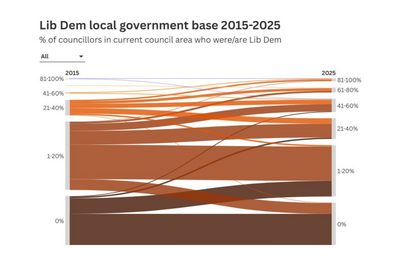
And we’ve seen it with local government growth too. In 2015, the proportion of principal authority councillors who were Liberal Democrat sank to its lowest level since 1983. Since then, we have recovered sharply, with consistent gains taking us up from 8% to 17% of councillors being Lib Dem. We are now within sight of the previous post-1973 high for our party or its predecessors (21% reached in 1996).
This growth has not only come from our stronger areas. It has been across the board, not universal, sadly, but overall our weaker areas have grown too. They have made progress less quickly than our stronger areas, but they have still grown. Crucially, the proportion of council areas with no Lib Dem councillors at all has fallen by 13%. That still leaves too many areas without a Lib Dem councillor. But it is progress.
Next steps
What comes next in building on this progress?
Part of that needs to be supporting local party officers. A few of these roles - such as treasurers - already receive significant training and support. But for most roles, training and support have been far more limited, especially for chairs - even though we know, from both inside and outside politics, that how a body or organisation is chaired makes a big difference to its success. That is now changing, with a national programme of training having started earlier this year.
It is also a good example of how we can combine helping target seats with growing more broadly. Both have local party officers who deserve access to high-quality training and support. But if you are doing that for target seats then, courtesy of tools such as Zoom, it is often very little extra effort to expand it more broadly too.
Part of that also needs to be Parliamentary candidate selection. The data show there is a consistent pattern of candidate selections boosting local party activity such as canvassing. Yet at too many elections, across different levels, we leave candidate selection until very late, with the result that smaller local parties, which most need such a boost, often miss out.
The big opportunity to put that right in this Parliament follows the reforms to our Westminster Parliamentary candidate system, voted for by Federal Conference last spring and then by all three State Parties, with the English Council, being the final one to do so, a few weeks ago, by 85%-15%.
Of course, we mustn’t expect non-target seat candidates to be in place for as long as target seat candidates. But getting more selections sooner will help more of our less strong areas get the full benefits from such post-selection boosts. That will also give for non-target seat candidates more time for training and support too, again something that is too often curtailed by short gaps between selections and elections.
And the very next steps are here
We saw at the 2024 general election another way to hit the double jackpot of supporting target seats while also helping to broaden our presence: providing common campaigning services that both can buy into. The extra volume achieved by opening such services to everyone reduces the prices for target seats, helping them, while opening up such services to other seats helps them step up their campaigning too.
We’ve done this before with the option to buy into centrally organised online advertising. Emails were recently sent to local parties with details of the latest round of this.
There is also something new, launched so far in England with Scotland and Wales to follow: an online campaign shop.
It gives every Lib Dem member instant access to a range of competitively priced, ready-made leaflets. All materials are produced by the same experts who support our top target seat campaigns.
So whether you're new to campaigning and want a ready-made leaflet, or running a big campaign and want something extra, the new campaign shop can help you.
It is starting with a few key items but will be expanding steadily over time - based on your requests and feedback.
Visit www.libdems.org.uk/shop and start benefiting.
FCEC cooptions and appointments
At our March meeting, we agreed to co-opt Jeremy Hargreaves so that he can then serve as the FCEC representative on our Federal Policy Committee (FPC), helping to join up our policy and campaign processes.
In a similar vein, a big theme of the candidate reforms mentioned above is to better join up our candidate and campaign planning. We therefore agreed to co-opt Alison Suttie, chair of the Joint Candidates Sub-Committee (JCSC), and also to make me our representative on that body.
Our third co-option was of former FCEC chair Tim Razzall to bring experience of previous Parliaments to our work and the final appointment was of myself as the FCEC representative on the Federal Conference Committee (FCC).